Workflow5 min read
How SLAB Connects Sales, Quoting, Production, and Inventory
Four departments touch one job, and every handoff between them is a translation that loses detail. Connecting them does not merge the roles — it means they all read from the same record.
Slab Team · 24 September 2026
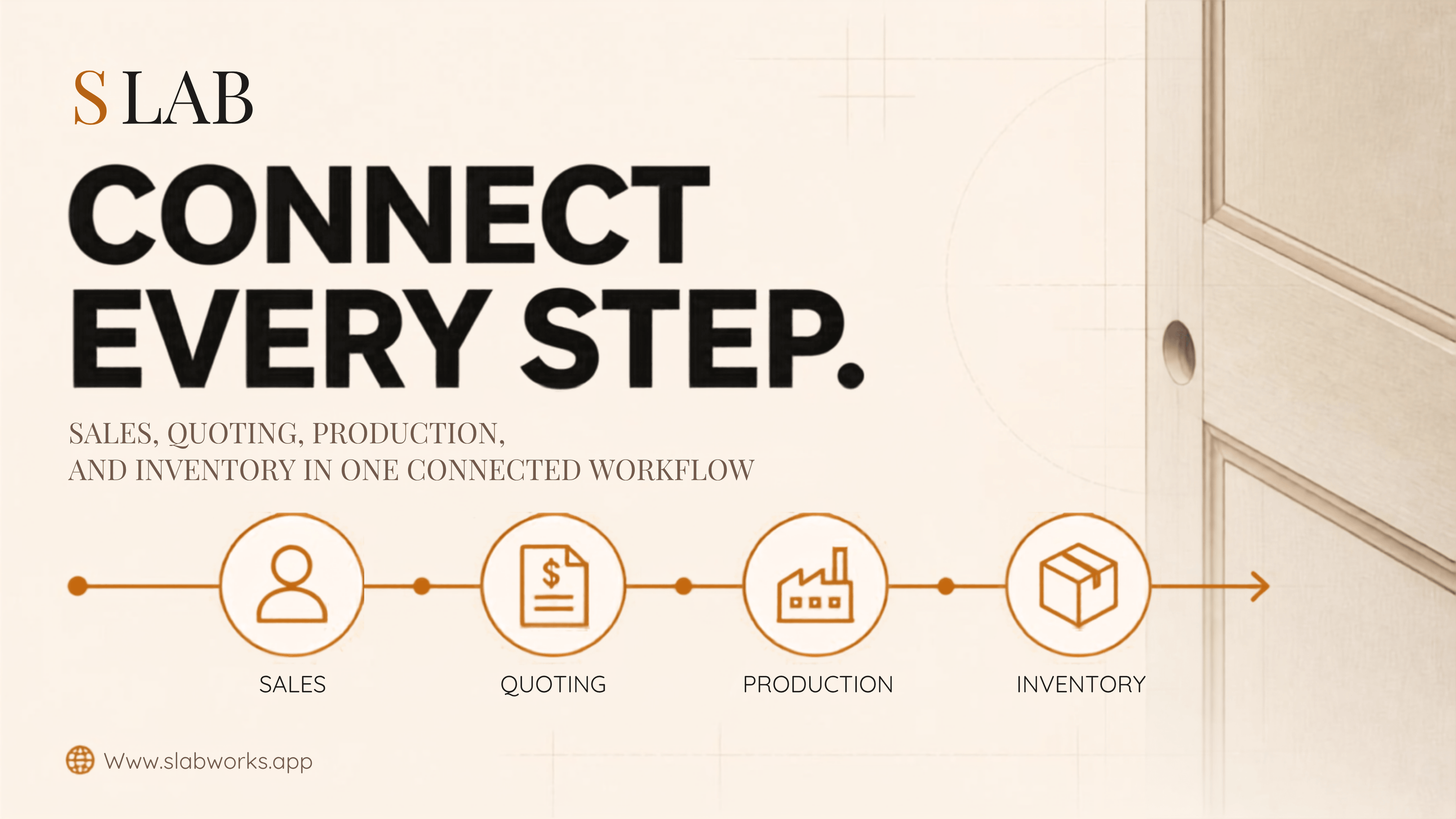
SLAB connects sales, quoting, production, and inventory by carrying a single job record through all four functions, rather than handing it off between separate tools at each step. A sales conversation becomes a quote, an approved quote becomes an order, and that order's specification drives both the shop floor's build plan and the inventory it draws from — automatically, without anyone re-entering the same details for each department.
One Sales Conversation, Four Departments Later
Trace what happens to a single customer inquiry. A sales rep talks through style, size, material, and hardware — choices pulled from the shop's own catalog rather than noted freehand. That conversation becomes a quote, priced automatically from the rules attached to those selections. Once approved, the quote locks and becomes the order, carrying its full specification forward. Production picks it up from there: a cut list and shop schedule generated directly from that same specification, and the materials it requires are checked against what's on hand, with anything missing flagged as its own tracked state rather than discovered mid-build.
Four departments touched one job, and none of them retyped anything the sales rep didn't already enter once.

Where This Chain Traditionally Breaks
In most shops, those four functions belong to different people using different tools. Sales keeps its own notes. An estimator builds a quote in a spreadsheet. Production works from a printed version of whatever the estimator sent over. Inventory gets checked separately — often reactively, when a machinist realizes mid-job that something's short.
Every one of those handoffs is a translation, and translations lose detail. A material substitution made on the floor doesn't always make it back to the original order. A quote revision doesn't always reach whoever's tracking materials. None of this happens because anyone's careless — it happens because the information genuinely has nowhere automatic to go once it leaves the tool it started in.
What Changes When It's One Record Instead of Four Handoffs
Connecting these functions doesn't mean merging four departments into one job title — sales, estimating, and the shop floor still do fundamentally different work. What changes is that the record they're all working from is the same one, so a change made by any of them is visible to the rest without a phone call or a retyped document. That's a meaningful part of why shops using SLAB have seen production errors fall by 42%: fewer of those errors originate from a department working off information that's already gone stale somewhere upstream.

Quick Answers
Do sales, production, and inventory need separate logins or interfaces? Each function has its own view suited to what that role needs to see, but they're all reading from the same underlying job record, not separate databases that require manual syncing.
What happens if inventory shows a shortage after a quote's already been approved? The shortage is visible as soon as materials are checked against the approved specification, giving production and purchasing the chance to react before a job is queued to build with something that isn't actually available.
Does this require sales and the shop floor to use identical tools? No, they interact with the parts of the system relevant to their role, but the data underneath is shared, so nobody has to translate between two disconnected tools to get a full picture of a job.
Can departments still get their own reporting? Yes. A connected data model doesn't mean a single undifferentiated view. Sales, production, and inventory can each surface the information relevant to them while still drawing from the same source.