Automation5 min read
How SLAB Helps Door Manufacturers Reduce Manual Work
Manual work in a door shop spreads thin across four handoffs, which is exactly why it is easy to overlook. Here is where it hides, and what a single record removes at each stage.
Slab Team · 10 September 2026
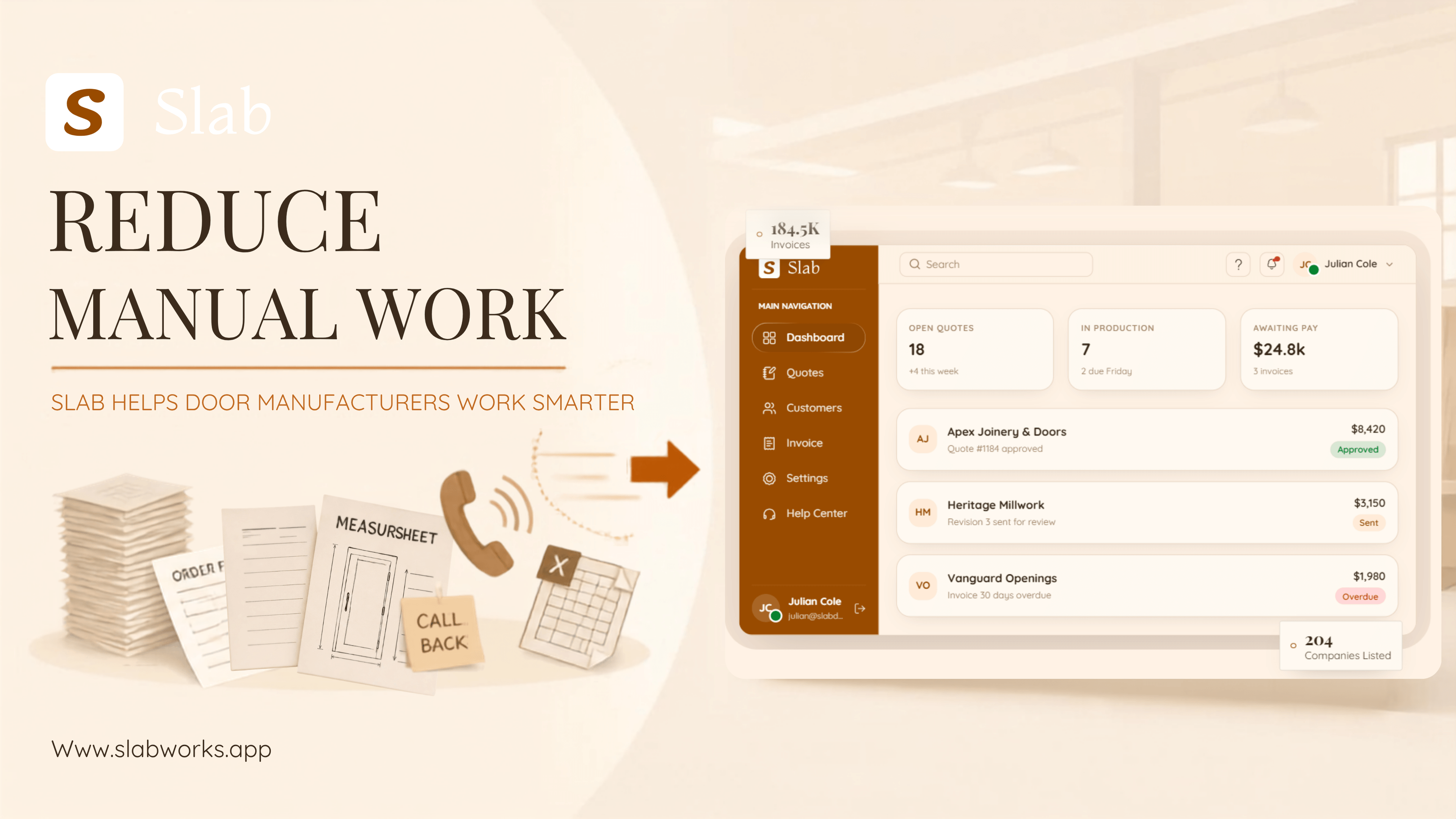
SLAB reduces manual work by removing the manual tasks (such as retyping) that occur when the same specs are written down, photographed, emailed, and re-entered by a different person at every stage of a job. Quoting, order entry, production, and invoicing are all pulled from a single record. Door shops using SLAB have seen quote time drop by 60% and operating costs fall by 20% as a direct result.
Where Manual Work Actually Hides in a Door Shop
Manual work in custom door manufacturing tends to spread thin across several handoffs, which is exactly why it’s easy to overlook. SLAB’s own founder has described touring a door manufacturing floor and finding measurements written on paper, photographed, and retyped into accounting software before a price was even calculated. That specific pattern is common enough across the industry that it directly shaped how SLAB was built, and it shows up in four places on almost every job.
-
Quoting starts from a blank form. Without the means a system requires to access prior pricing and configurations, every estimate has to be rebuilt from scratch, even for jobs similar to ones already quoted dozens of times before.
-
Specifications get handed to the shop floor as printouts and phone calls. A cut list arriving on paper leaves a machinist having to figure out “scribbles” rather than building from a locked, unambiguous specification.
-
Production status lives in someone's memory or on a whiteboard. Checking where a job stands means walking the floor or calling someone who knows, rather than looking it up from a computer.
-
Invoices get rebuilt from the original quote. Even though the pricing was already itemized, billing often means manually reconstructing it after the job ships.
What SLAB Automates at Each Stage
Quoting pulls from the shop's configured catalog (door styles, materials, finishes, hardware, and the pricing rules attached to them) instead of a blank template, so an estimator is selecting from existing options rather than typing every detail from memory.
Specification transfer happens automatically: once a quote is approved, it locks and becomes the order, carrying every piece of information forward to production without anyone re-entering it.
Cut lists and shop scheduling generate from that same locked specification, replacing printouts that have to be interpreted with a plan built directly from the job's actual data.
Invoicing runs on stage-based billing tied to where a job sits in the pipeline, rather than a document manually rebuilt from the quote after delivery.
Change tracking happens automatically — every edit, stage change, and restore is logged with who made it and when, replacing the manual work of figuring out which version of a job is current.
Frequently Asked Questions
-
Does this replace people, or just remove manual tasks? SLAB removes the retyping and re-checking work — building a quote from scratch, re-entering a specification for production, manually rebuilding an invoice — not the judgment calls a sales rep or shop manager makes. Approvals still happen; they just don't require duplicate data entry to act on.
-
Is pricing fully automated, or does someone still set it? Pricing rules are configured by the shop and applied automatically once a door's style, materials, and hardware are selected. The rules are set by the business, not decided independently by the software.
-
Does reducing manual work mean removing approval steps? No. Quotes still go through sales submission and manager approval before advancing to production. What changes is that approval doesn't require re-entering the same specification into a second system afterward.
-
How quickly do the time savings show up? Because quoting and specification transfer are largely mechanical changes, the time savings on those specific tasks tend to be immediate, while broader operating-cost reductions accumulate over time as re-entry and rework are removed across more of the workflow.