Quoting4 min read
How to Improve Quoting for Custom Door Manufacturing
Speed and accuracy in quoting get treated like a trade-off. They are not — the shops that quote well have simply removed the bottleneck that puts the two in tension.
Slab Team · 16 July 2026
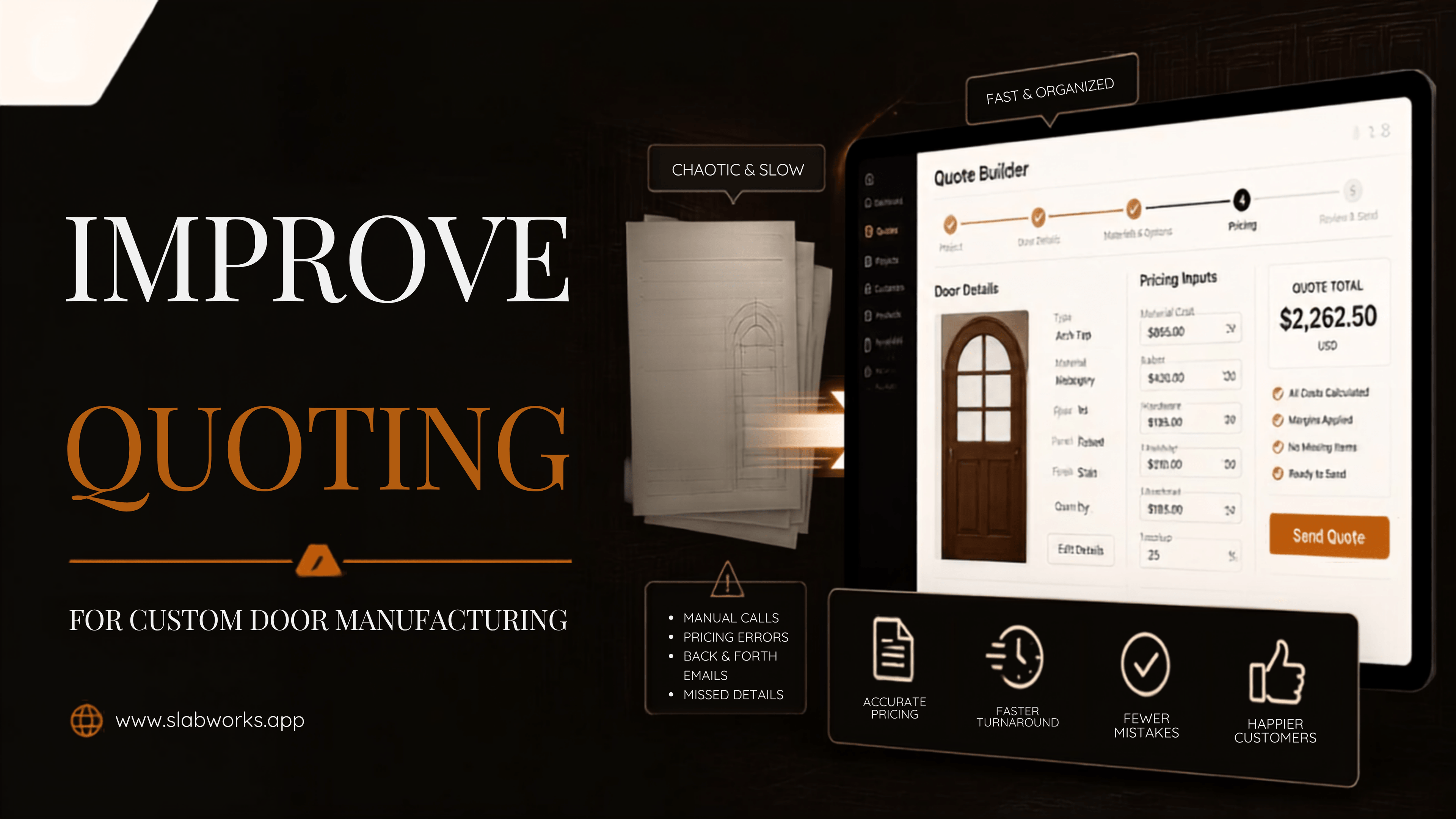
There’s that story of a quote that came back wrong on that one job. One that most custom door manufacturers can relate to. It could be a material that was miscalculated, or a price that didn’t hold up once production starts. Those stories get told because they’re worth remembering. What doesn’t get told nearly as often is the job that went to a competitor simply because their quote arrived first.
In most conversations about quoting, speed and accuracy get treated like a trade-off or an afterthought. Picking one to sacrifice the other, in most cases. It is a wrong framing. Businesses that prioritize quoting well aren’t choosing between the two. They’ve simply removed the specific bottleneck that makes speed and accuracy feel like they’re in tension.
What an Accurate Quote Requires
Before we go into diagnosing what slows the quoting process, it’s important to note that quoting isn't one task. It's four, bundled together. Here's what each task has to get right before you can diagnose what's slowing the process down.
Materials
The specific combination of wood, glass, hardware, and finishing a custom order requires being priced against current material costs, not last quarter’s cost or a rough estimate.
Labor
The time a given custom specification will take to produce, which varies meaningfully between a standard configuration and something genuinely custom.
Specifications
The exact dimensions and details of the order, captured accurately enough that the production team can build from them without a round of clarifying questions later.
Pricing logic
The margin, adjustment, and business rules that turn “this is what it costs to make” into “this is what we charge for it,” consistently.
Chances are that if you get any of these four wrong, it affects the quote. Get all four right but take three days to do it, and your customer’s already talking to someone else.
Where Quoting Breaks Down
-
Starting from nothing, every time: The most common bottleneck is the absence of memory. A manufacturer that rebuilds every quote from scratch without reference to past jobs priced beforehand is re-solving a problem that has already been solved a dozen times. The result is time lost with no accuracy benefit to show for it.
-
Specifications that travel across different departments badly: A measurement taken on a piece of paper, photographed, and re-typed by someone leaves much room for errors before pricing even starts. Every one of those handoffs is a place where “8 and ¾ inches” can become “8 and ⅝,” and nobody notices until the door doesn’t fit.
-
Pricing logic that lives in someone's head: In a lot of shops, the “system” for pricing custom work in person is usually someone who’s been there long enough to price jobs by feel. That might work until the person is out, burnt out, or eventually leaves the business, and the pricing leaves with them as well.
-
No connection to what happens next: A quote that exists in isolation—disconnected from the order it relies on, the production schedule it feeds into—has to be manually translated at every subsequent stage. That’s not a quoting problem specifically, but where quoting problems compound: an error that starts at the estimate doesn’t get caught; it gets built.
What a Slab Quote Looks Like
Enter the specification once, and Slab carries it through the rest of the job. Estimators can build quotes using pricing from similar jobs already in the system, rather than recreating calculations from scratch.
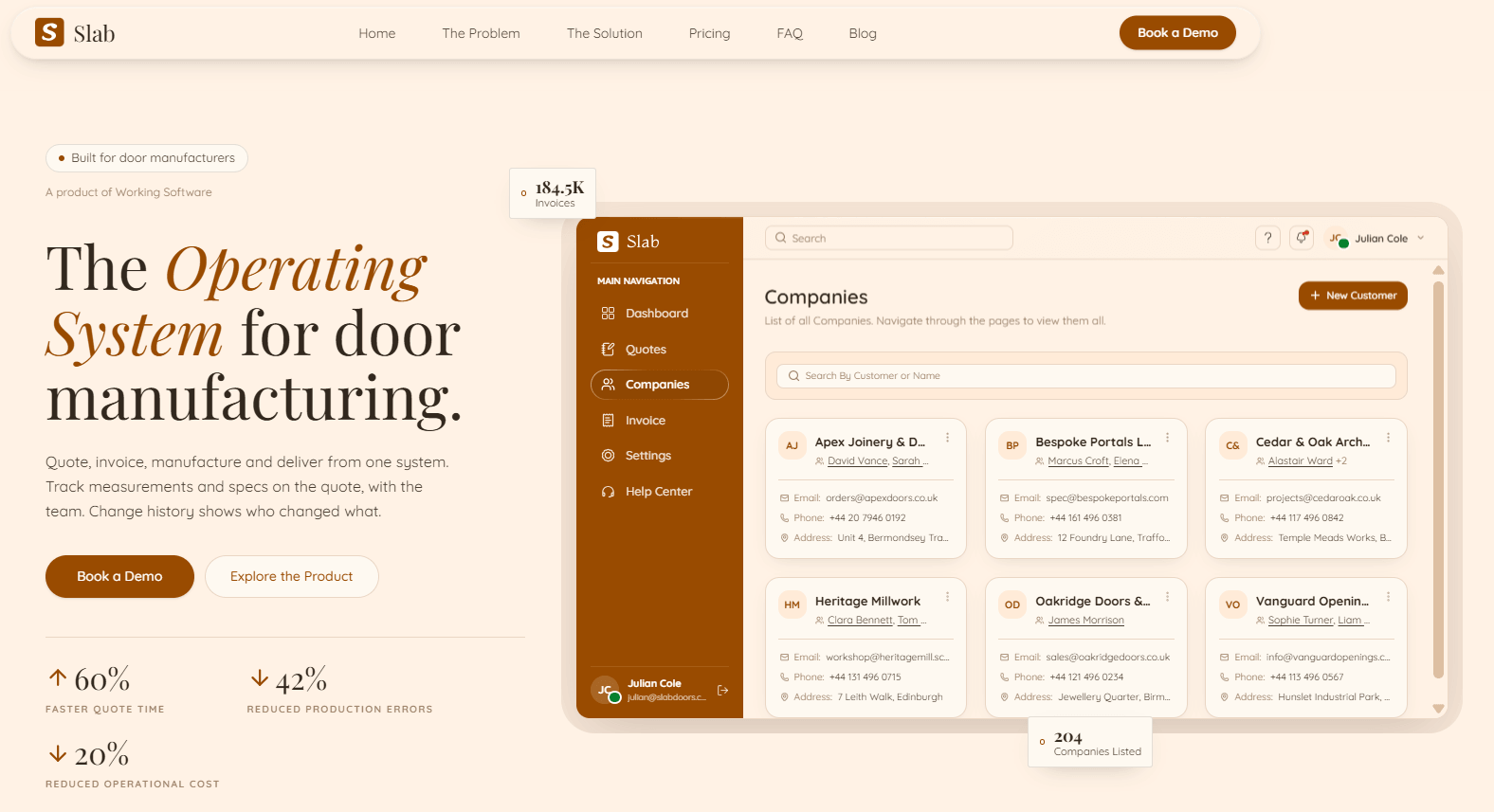
Once the customer approves the quote, it becomes the order. The dimensions, materials, and other specifications move directly into production without being re-entered or manually translated.
That is the key difference. Slab doesn't just make quoting faster—it removes the need to rebuild the same information at each stage. One specification serves as the quote, order, and production record, reducing both administrative work and errors associated with repeated data entry.
Three Questions to Ask Before You Trust Any Quoting Tool
Whether it's Slab or something else, a quoting system is only worth adopting if it can answer three questions well:
- Does it pull from historical pricing, or does every quote start from zero?
- Does the specification it captures carry forward automatically into production?
- Or does someone have to re-enter it?
A tool that answers all three is solving the actual problem. One that only speeds up data entry is solving a smaller one.