Production5 min read
How to Track Production in a Custom Door Manufacturing Business
Pick a job in your shop. What stage is it at, how long has it been there, and is anything blocking it? If answering takes a walk to the floor, that is what poor visibility is costing you.
Slab Team · 9 July 2026
Introduction
Pick any current job in your shop. Done? Then, quantify how long it takes to answer three questions: What stage is it at now? How long has it been there? Is anything preventing it from moving forward?
If answering these questions requires you to walk around the facility, make a call to a supervisor, or go through a whiteboard, then there’s a major problem on your hands. It represents the core failure that this article addresses, and it’s costing more than most custom door manufacturers realize. These costs accumulate as numerous small delays that add up over time.
What Tracking Production Means
In practice, real production tracking means four specific things are found to be true at all times, not just when someone checks.
Current Stage
This stage shouldn’t just be streamlined as “in production,” but the actual steps that account for: cut, assembled, finishing, in quality control, staged for delivery.
Time in Stage
This deals with how long a job has sat at its current step, because a job stuck for six hours looks identical to one stuck for six days if all you’re tracking is a status label.
Blockers
Whether a job is actively moving or waiting on something like a material, a machine, or a decision.
Visibility beyond one person
Whether multiple people in management can answer the questions as mentioned in the introduction, without interrupting production to ask.
Most manufacturing businesses have some version of the first one. Very few have all four, and the ones that are missing tend to be the ones that create the most costly surprises.
How Door Shops Convince Themselves They're Tracking Production
-
The whiteboard. It’s simple, cheap, and works exactly as well as whoever’s updating it does so. When a job moves and the board doesn’t get updated for a few hours, everyone looking at it is working based on information that’s already wrong.
-
Single source of knowledge. In many door shops, their “system” is just one person, usually the floor manager who might know where everything is, because they’re the one walking the floor constantly. This works well right up until the person is out sick, in a meeting, or has exited the company, and the business discovers it had a single point of liability wearing a name tag.
-
The after-the-fact spreadsheet. Most door shops usually track production by updating a spreadsheet at the end of the day, which technically counts as tracking, but only tells you where things were, not where they are. Imagine if a customer calls at 2 p.m. asking for a status update, and yesterday’s spreadsheet doesn’t answer today’s question.
The Real Problem Isn't Reporting. It's Redundancy
Here’s something to think about: the problem isn’t that door manufacturers lack reports. It’s that they’ve built visibility around a single point of failure—one whiteboard, one person, one end-to-end update on a spreadsheet—instead of a system that reflects reality continuously and can be checked by multiple people at once in the company.
That distinction matters greatly, because it changes what “fixing it” looks like. Adding more check-ins, more status meetings, or a more sophisticated spreadsheet doesn’t solve a single-point-of-failure problem. It just adds more manual steps on top of the same fragile foundation. The solution is not more reporting. It’s removing the dependency on any one source of truth.
What Poor Visibility Costs You
The real cost of poor production visibility shows up downstream, in customer communication. A customer asks for an update on an order, and the answer requires someone to go find out, then call back. Now, multiply that across multiple active orders, and it’s hours a week spent gathering information that should have been available instantly.
Best-case scenario, when a job is halted by missing or another delayed job, real-time visibility lets the team act immediately. Without it, the issue may go unnoticed for days, pushing delivery dates and resulting in difficult conversations with customers.
What Purpose-Built Dashboard Actually Shows
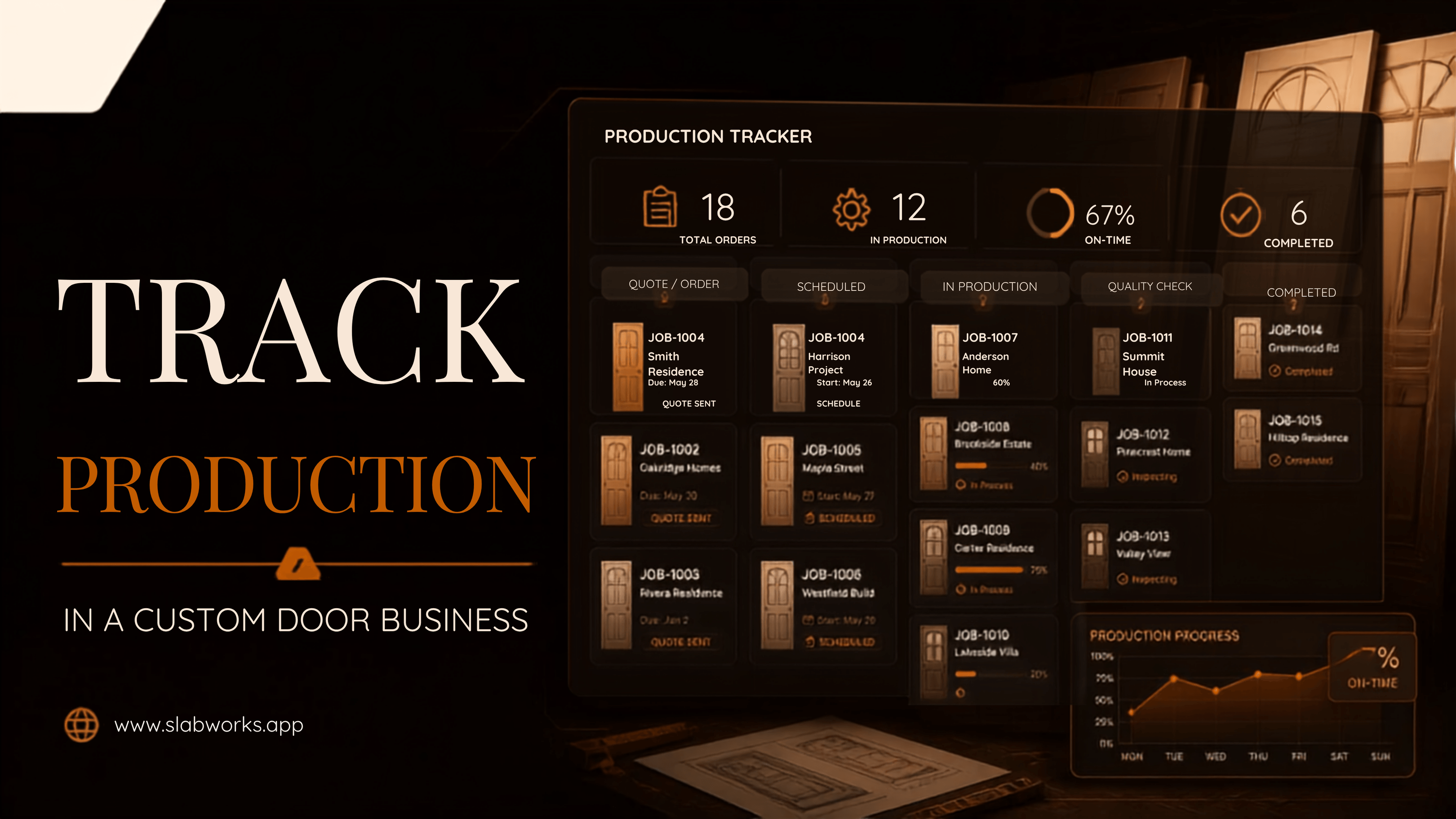
Open a live production dashboard built for this specifically, and it looks less like a report and more like a snapshot of the entire operations at once: a count of active orders, how many orders are currently in production, how many are sitting and awaiting materials, how many are through production and staged for quality control, and how many are ready for delivery. Every number detail reflects the current state of a real order.
This is where a purpose-built system earns its distinction from the “generic” tools most door manufacturers already use. A CRM tracks customers. Account software tracks money. Neither one has any concept of “this door is currently in the finish stage and has been for hours.” Production tracking shouldn’t be thought of as a feature you merge onto either of those categories. It’s a different kind of system entirely, and one built around the physical reality of a job moving through a door manufacturing shop, not the paperwork around it.
Slab’s production view works this way by design, where every job’s stage updates as it actually moves, visible to anyone who needs to check it, be it sales, ownership, or the front office, without having to interrupt production. A customer status update stops being a research-intensive task and becomes a quick lookup in seconds.
Final Thoughts
Instant visibility does more than save time. It reduces reliance on individual memory and makes the operation easier to manage. Sales can answer customer questions without bothering production for updates. Managers can step away without taking critical knowledge with them. Delays can be identified and addressed as they happen rather than days later. The value is having the right information available when someone needs it.