Operations5 min read
How SLAB Manages Orders, Inventory, Production, and Customers in One System
Most shops already have a CRM, a quoting spreadsheet, a production process and some way of tracking materials. What they lack is the connection between them — and that gap is where the expensive mistakes start.
Slab Team · 3 September 2026
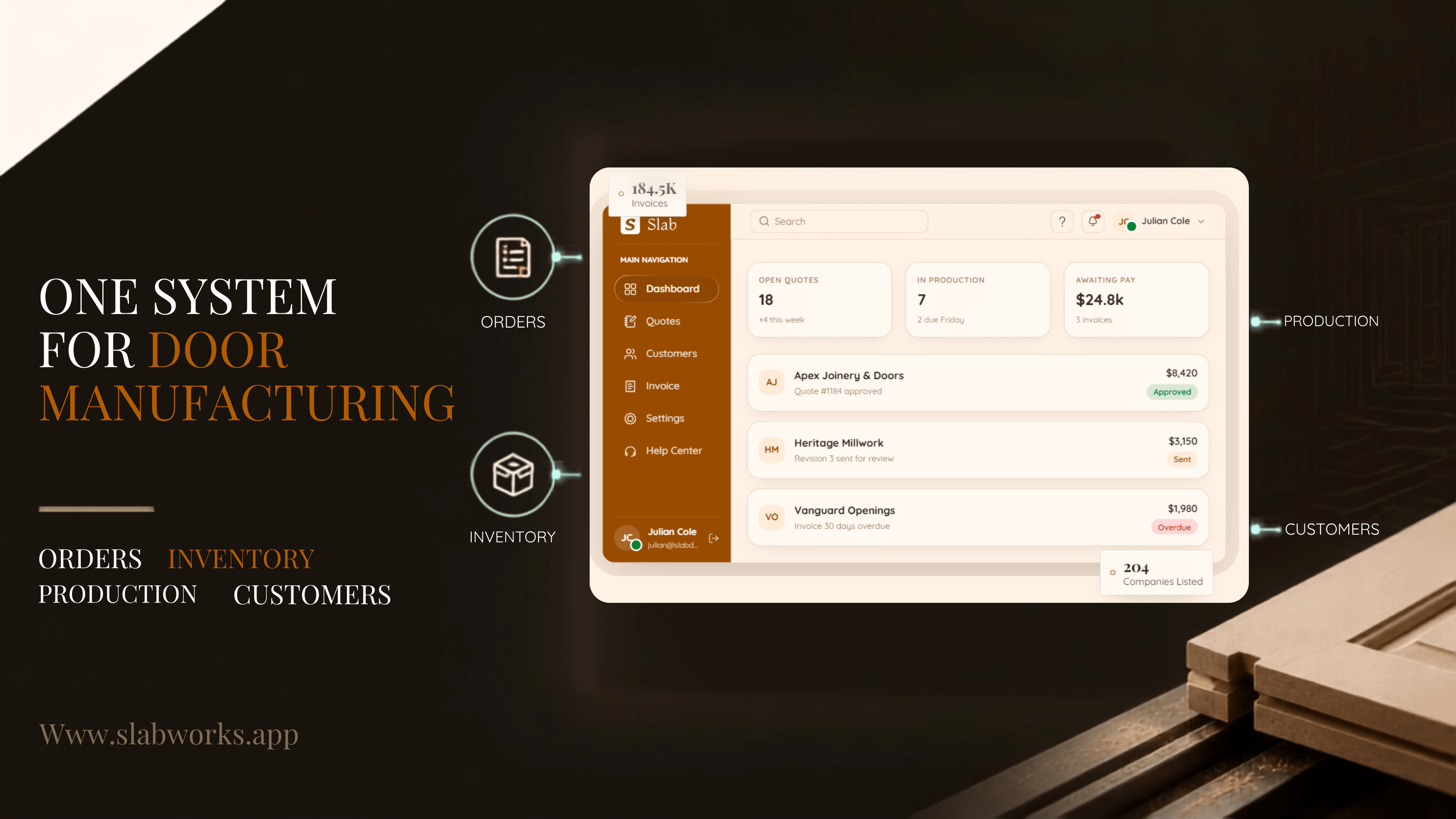
SLAB manages orders, inventory, production, and customers in a single system by linking every part of a door job (the customer record, the order specification, the production stage, and the materials it consumes) to a single record, rather than scattering them across separate tools. When a quote becomes an order, that change is automatically visible everywhere the order shows up next, rather than requiring someone to update a CRM, a production schedule, and an inventory count separately by hand.
How Customer Information Connects to Every Order
Company records, contracts, and billing and shipping addresses live directly with the quote itself. When a customer receives a quote PDF, it’s generated from the same record without having to be assembled separately by an accounting team copying details from a CRM into a document. For a returning customer, that means an order doesn’t start from a blank contact form—it starts from a history that’s already available.
How Orders and Production Stay in Sync All the Time
An approved order becomes the order, automatically carrying specification (style, materials, finish, hardware, quantities, and pricing) forward, without the manual effort of re-entering information. From there, the job then moves through a defined pipeline: Draft, Pending Review, Approved, Production, Shipped, Delivered. Once a quote is approved, it locks against further sales edits, so the shop floor is always building on the version that was signed off on. Every workflow stage change, edit, and restore is logged with a timestamp and the person responsible, so there’s never a question of which version of a job is current.

How Inventory Connects to What's Actually Being Built
Here material status is tracked alongside production rather than separately. Orders waiting on materials show up on their own visible state tag: “awaiting materials”— instead of a shortage management discovers mid-build or has to check in with the shop floor. Cut lists and shop scheduling are generated from the same system as the order itself, so material planning reflects the actual specification of the order, not a printout interpreted separately by whoever’s running the saw machine that day.

Why One Connected System Beats Four Disconnected Ones
Most shops don’t lack any of these functions individually. They have a CRM, a quoting spreadsheet, a production process, and some system of tracking materials. However, what they usually lack is the connection between them. Every handoff between separate systems of records is a place where information gets retyped and where specifications drift. A customer’s shipping address updated in one place and left out in another, or a production delay that isn’t visible to sales teams when the customers call about their order.
Connecting customers, orders, production, and inventory into one streamlined system doesn’t just save the time spent updating four record systems instead of one—it closes the specific gap where those four systems stop agreeing with each other, which is where most costly manufacturing mistakes originate.
Frequently Asked Questions
-
Does SLAB replace our existing CRM?
SLAB keeps customer records attached directly to quotes and orders, functioning as the customer database for the manufacturing workflow itself, rather than a separate CRM a shop has to keep in sync with production data.
-
Does SLAB track real-time inventory levels?
Material status is tracked as part of the order, including a distinct "awaiting materials" stat —and cut lists and scheduling are generated from that same data, so shortages are visible as part of production tracking rather than a separate manual count.
-
Can more than one person see a job's status at the same time?
Yes. Because orders, production status, and inventory are tracked in one shared system, anyone with access (sales, ownership, the shop floor) can check a job's current status without interrupting someone else to inquire.
-
What happens if a customer changes an order after it's approved?
Changes after approval go through the same review process as the original quote, rather than a “silent edit,” so the shop floor never ends up building from a change nobody signed off on.