Software5 min read
How SLAB Replaces Spreadsheets, Paper Job Folders and Disconnected Software
Each of the three tools a door shop runs on fails differently — so each one gets replaced differently. And one thing does not change: a shop still has to know its own process well enough to configure it.
Slab Team · 8 October 2026
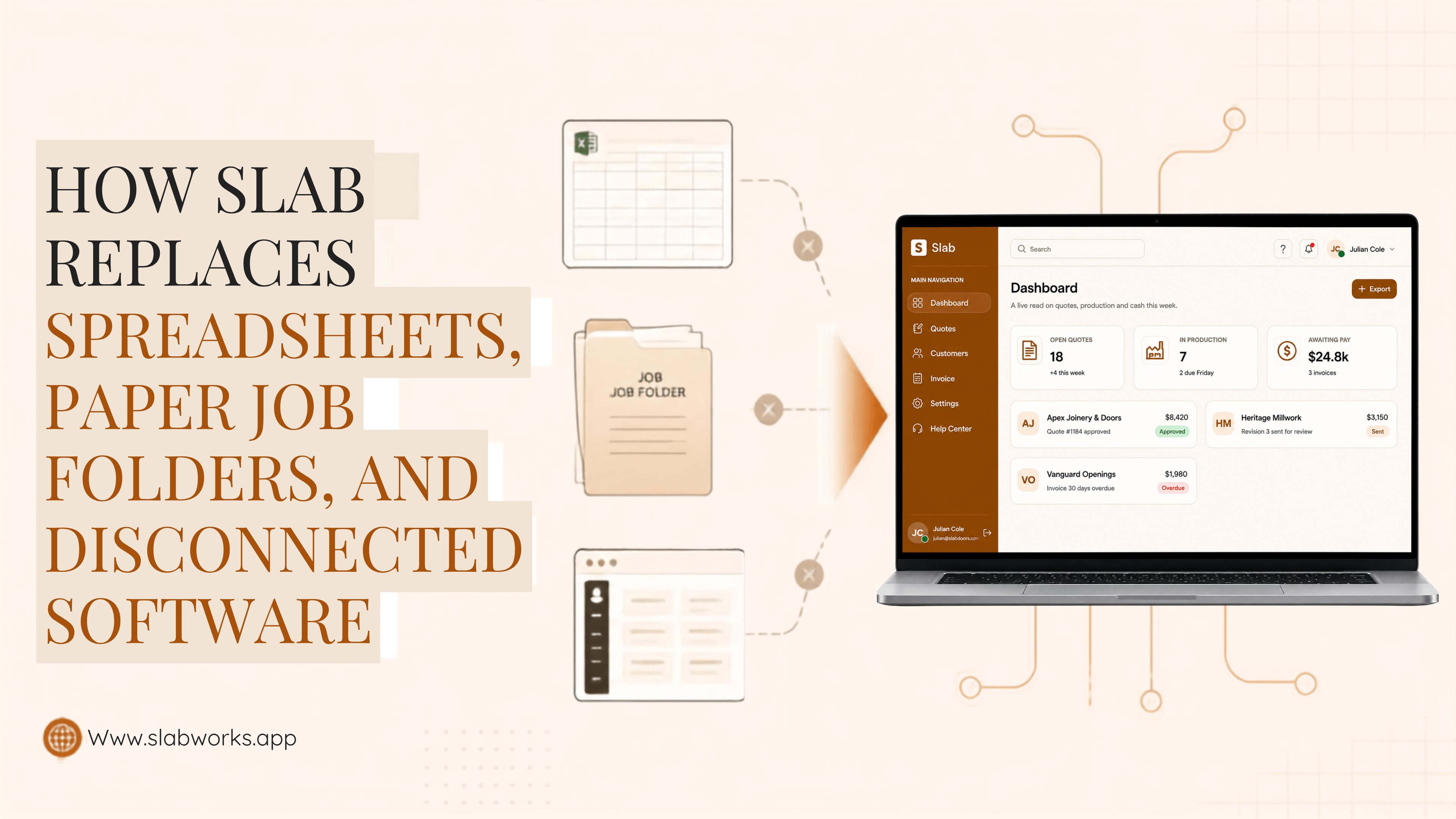
SLAB replaces spreadsheets, paper job folders, and disconnected software by providing a door shop with a single system where quoting, customer records, production, and inventory all read from the same data — eliminating the specific failures of each of those three tools in a custom manufacturing environment. Each one fails differently, so each one gets replaced differently.
The Spreadsheet Problem
Spreadsheets are genuinely good at calculation and genuinely bad at being a shared, real-time source of truth. Two people editing the same file create version conflicts. A formula built by whoever set the sheet up years ago breaks the moment someone unfamiliar with it edits the wrong cell. And a spreadsheet has no natural connection to what happens after a quote — it doesn't know when an order ships, doesn't track who changed a price, and doesn't update itself when a job moves to the next stage.
SLAB replaces the calculation with pricing rules attached directly to a shop's own catalog, so quoting doesn't depend on a formula surviving years of edits, and every change is logged automatically, closing the "which version is current" problem that spreadsheets create by design.

The Paper Job Folder Problem
A physical folder that travels with a job has a failure mode spreadsheets don't: only one person can hold it at a time. If sales has it, production can't reference it. If it gets left in a truck or damaged on the shop floor, whatever wasn't backed up elsewhere is just gone. There's no search, no history of what changed, and no way for two people in two locations to check the same job at once.
SLAB replaces the folder with a record that isn't physically located anywhere. Sales, the shop floor, and inventory can all reference the same job simultaneously, and nothing about it depends on a piece of paper staying in one place.

The Disconnected Software Problem
This is the subtler failure, because it doesn't look like a problem at first. A shop that's "modernized" often ends up with several decent tools — a CRM for customers, a spreadsheet or basic tool for quoting, something else for invoicing — each one fine on its own, none of them talking to the others. Someone ends up serving as the manual integration layer, retyping a customer's details from the CRM into a quote, then retyping that quote into whatever handles invoicing. The tools improved; the retyping didn't go away, it just moved.
SLAB replaces the collection with a single connected system, where customer records, quotes, orders, production, inventory, and invoicing share one underlying record instead of requiring someone to keep several separate ones in sync by hand.
What Doesn't Change
Worth being direct about this: switching off spreadsheets and paper doesn't remove the need for a shop to actually define its own catalog, pricing rules, and workflow accurately during setup — the system reflects what it's configured to do, not a generic assumption about how every shop operates. And the approval discipline that makes a locked quote meaningful still depends on someone actually reviewing it, not just clicking through. The software removes the manual re-entry and version confusion; it doesn't remove the need for a shop to know its own process well enough to configure it.
Before You Switch
Do we lose our historical data from old spreadsheets? Historical records don't have to be discarded when moving off a spreadsheet. The more relevant question is usually how much of that history is worth manually migrating versus starting current jobs fresh in the new system.
Can we keep paper as a backup during the transition? Most shops run some overlap period rather than an instant cutover, though the value of the connected system depends on the team actually working from the shared record rather than defaulting back to paper out of habit.
Does switching require retraining everyone at once? Not necessarily, because different roles interact with different parts of the system—teams can often be brought on in stages rather than all at once.
What if our shop's process doesn't match a standard setup? The catalog and workflow are configurable specifically so a shop's actual process is what gets built into the system during setup.