Production5 min read
How SLAB Helps Door Manufacturers Track Every Job From Quote to Delivery
Most shops track the middle stages well enough. Visibility falls apart at the edges — the approval step before anything reaches the floor, and everything that happens after a door leaves the building.
Slab Team · 1 October 2026
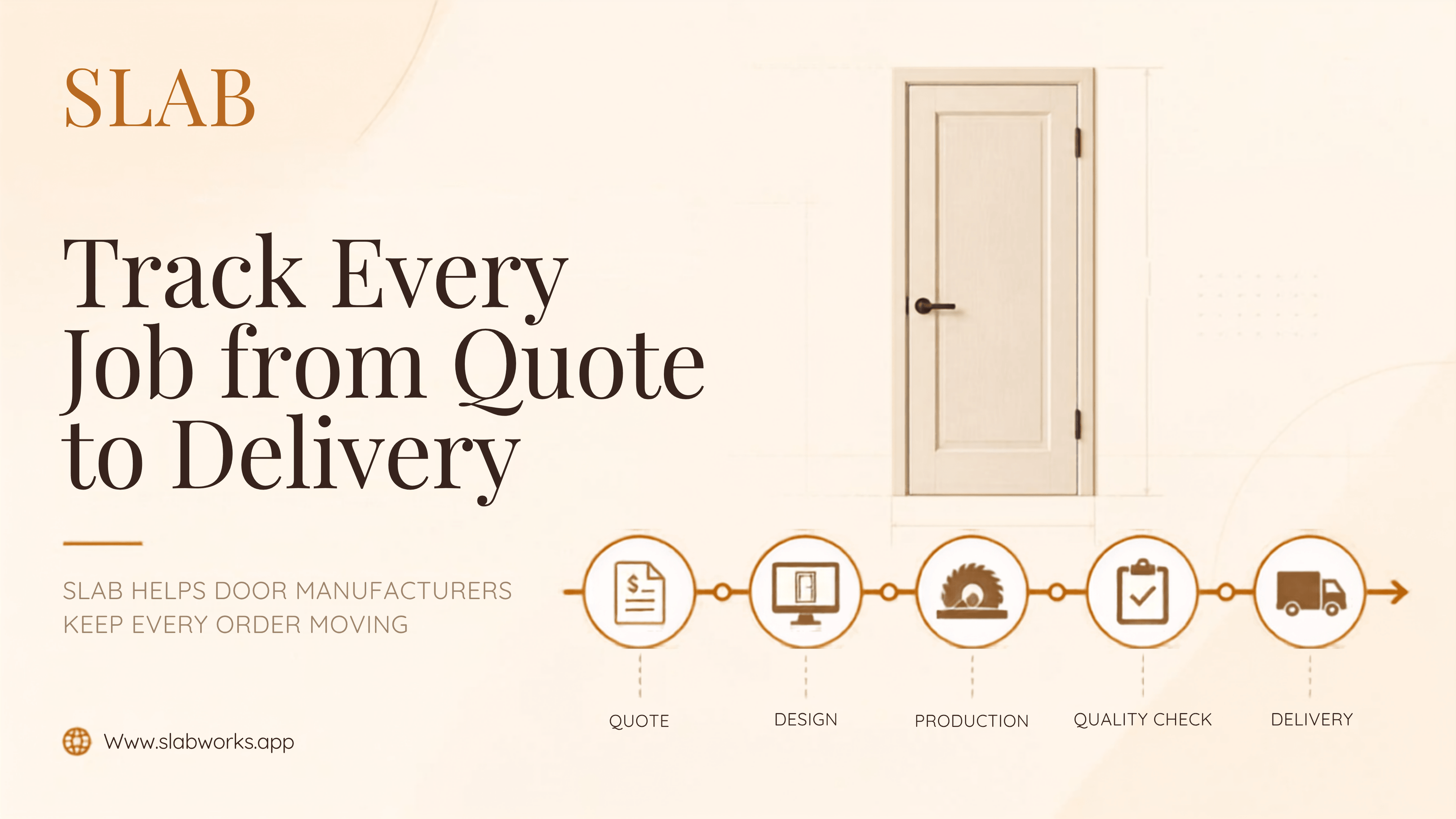
SLAB tracks every job from quote to delivery by moving it through six defined stages — Draft, Pending Review, Approved, Production, Shipped, and Delivered — with each stage change logged and visible to anyone who needs to check it. No whiteboard to walk over to, no phone call to the shop floor, no spreadsheet that's only accurate as of whenever someone last updated it.
The Six Stages a Job Actually Passes Through
Draft. The job exists as a configured quote — style, size, materials, hardware, and pricing selected from the shop's catalog, not yet submitted for approval.
Pending Review. Sales has submitted the quote, and it's waiting on a manager to check it before anything moves forward.
Approved. The quote is signed off and locks against further sales edits. This is the version everything downstream (production, shipping) will build from.
Production. The job is actively being built, with a cut list and shop schedule generated from the locked specification.
Shipped. The finished door has left the shop.
Delivered. The order is confirmed and received by the customer.
Most shops track some version of the middle stages reasonably well. Everyone knows when a job's "in production." Where visibility usually falls apart is at the edges: the review-and-approval step before anything reaches the floor, and everything that happens after a door leaves the building.
The Blind Spot After the Door Leaves the Bay
Once a door ships, tracking often reverts to whatever a shop used before it had a system — a spreadsheet, a whiteboard, or a driver's memory. That means nobody can say with confidence what's actually left the building, what's arrived, or what's still sitting on a truck somewhere between the two. It's a strange gap, because it's often the stage a customer cares about most immediately: "is it here yet" is a more common question than "what stage is it in production."
Treating Shipped and Delivered as tracked stages inside the same system that handled the quote closes that gap. A job's status doesn't stop being answerable the moment it leaves the shop's own walls.
Why "Where Is This Job?" Should Never Require a Phone Call
The practical payoff of tracking a job is that answering a status question stops being a research task. For a customer asking where their order stands, that's the difference between an answer given on the spot and a callback after someone's gone to check. For an owner reviewing the business, it's the difference between a real picture of everything currently in motion and a snapshot that's only as fresh as the last time someone manually compiled one.
Answers to Common Questions
Does tracking cover third-party freight, or only in-house delivery? The Shipped and Delivered stages track a job's status within SLAB regardless of how it's physically transported. The system reflects what's known about a job's movement, not the specifics of who's driving it.
Can a customer see their own order status directly? Status is generated from the same record used internally, which makes it straightforward to share a customer-facing view of where an order stands, though the specifics of what's shared depend on how a shop sets that up.
What happens if a job needs to move backward, say, it fails quality control? Every stage change, edit, and restore is logged with who made it and when, so a job moving backward is recorded the same way as any other change; visible, not silent.
Is a "Delivered" status set automatically or does someone confirm it? Marking a job delivered is a deliberate stage change like any other in the pipeline, which keeps the record accurate rather than assuming delivery the moment something ships.